



Research Projects:
- Shock to Detonation Transition in Multi-Dimensional Homogeneous Explosives:
- Multi-Scale Lagrangian Method for Energetic Materials:
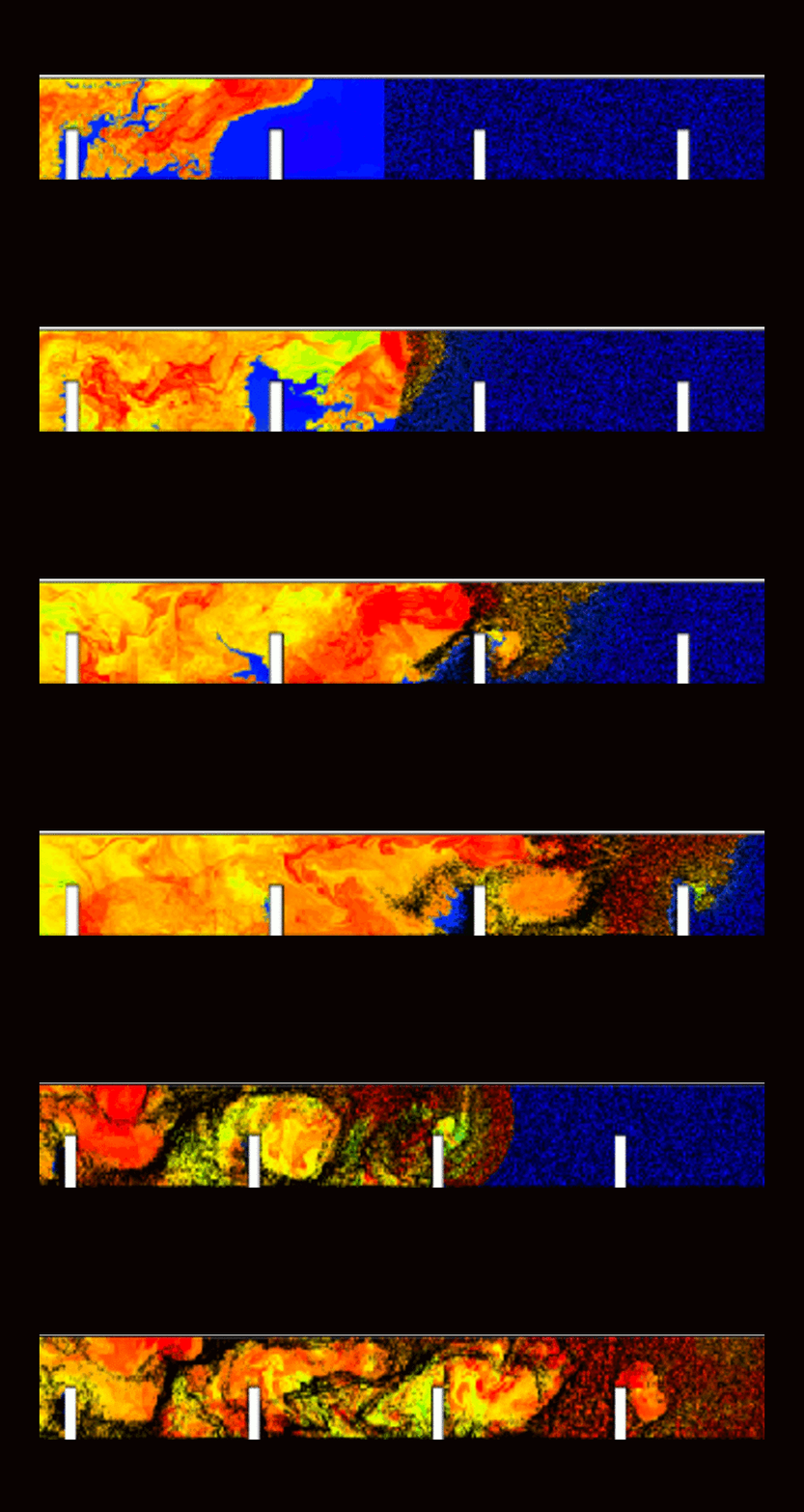
Impact sensitivity of condensed phase explosives is a critical design parameter as replacements for existing explosive materials are sought. Numerical proceedures are developed and validated for existing explosive materials in two explosive families: benzene-/nitrate-based explosives pentaerythritol trinitrate (PETN) and triaminotrinitrobenzene (TATB) and nitroamine-based explosives hexanitrohexaazaisowurtzitane (CL-20) and octagen (HMX). These studies reveal a collapse in impact sensitivities for each family of explosives when the pressure is scaled based on theoretical and/or experimentally available proprties. This scaling allows the predicition of impact sensitivity for novel explosives that are in the same families. Studies of the transition process in 2D and 3D reveal that the transient heat release drives the transition process. The increased heat release in the 3D simulations changes the transient process of the transition by reducing the run-up distance and increasing the pressure sensitivity of the run-up distance while the final, steady-state detonation properties remain unchanged. Therefore, 2D simulations are sufficient for studying many processes including the impact sensitivity which allows rapid prototyping.
A structured Lagrangian model originally developed for the investigation of erosion and corrosion in industrial applications is extended to simulate applications of energetic materials. The proposed model is part of a system of tools used to bridge the multiple spatio-temporal scales from molecular through macro-scale. Two different applications of energetic materials are investigated: first, the surface burning and regression of Ammonium Percholorate/Hydroxl-terminated polybutdiene rocket fuel with and without titanium dioxide nanoparticles is shown to match existing experiments and models; second, the low-speed impact of the nano-scale material interface in an Octagen-Estane plastic-bound explosive is shown to generate high temperatures along the interface consistent with both quantum molecular dynamics and cohesive finite element simulations.